

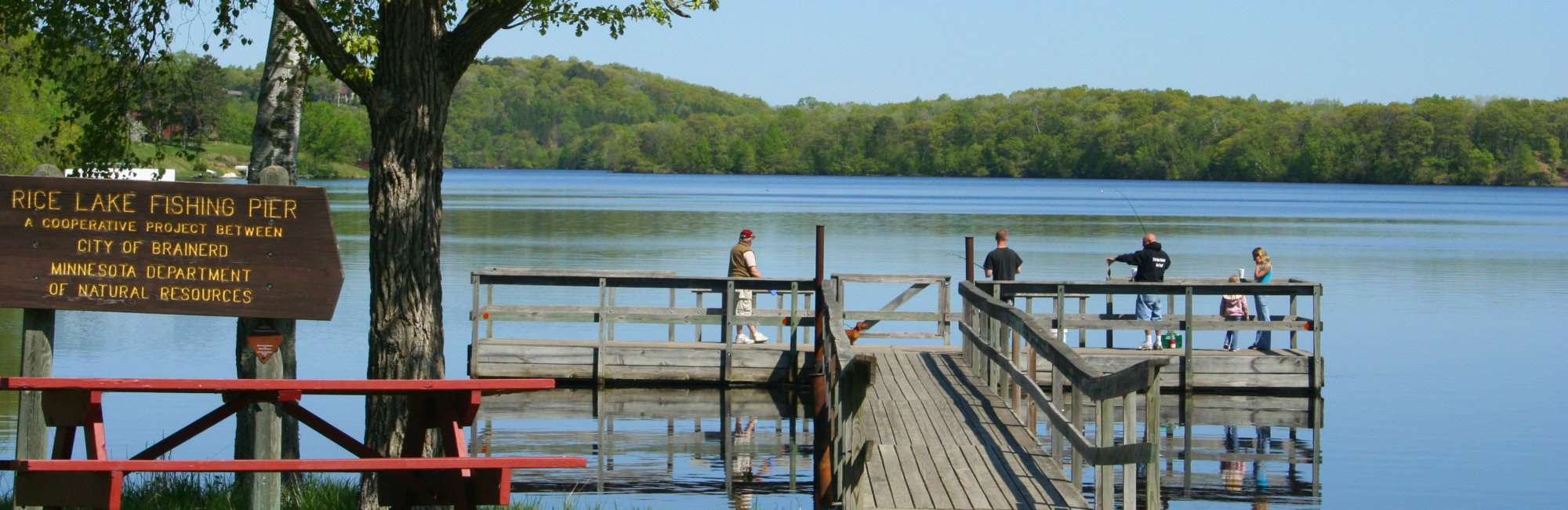
Minnesota Fish Facts & Information
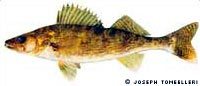 Walleye
The state record for Walleye is 17 pounds, 8 ounces. The walleye is the most sought-after fish in Minnesota. Its thick, white fillets, and elusive nature make it the ultimate prize among anglers. The average Walleye caught and kept is about 14 inches long and weighs slightly more than a pound. The walleye is named for its pearlescent eye, which is caused by a reflective layer of pigment, that allows it see and feed at night or in murky water.
Each year, more than one million anglers pursue the walleye in more than 1,700 lakes. In 1965, the Legislature named the walleye Minnesota's official state fish. Walleyes do most of their feeding in the morning and at sunset, which is usually the best time to catch them. Walleye's habitat are lakes, slow-moving rivers, reservoirs, and some ponds. The walleye is found in these types of waters throughout Minnesota. Minnesota's walleye stocking program is the largest in North America.
Walleye tips: Walleyes will bite best on live bait. You just need to choose a lure or rig to put the bait in front of them, and the best things for that are jigs, live bait rigs, and bobber rigs. The best jigs to use are pink, white, yellow, or florescent green and weigh 1/16-1/4 ounces. Walleye are found on the Pelican Lake, Round Lake, Gull Lake Chain, Whitefish Chain, Mille Lacs Lake, and Leech Lake.
Walleye Fun fact: Did you know that studies have shown that walleyes live as long as 29 years in some waters?
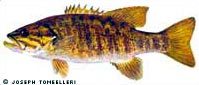
Small-Mouth Bass
The state record Smallmouth Bass is eight pounds. Sometimes called a “bronze back," the smallmouth is one of the strongest fish for its weight. Many anglers who hook a two-pounder will think it’s twice that size until the it's in the net. Smallmouth are native to the Mississippi River watershed. They are abundant in warm southeast Minnesota rivers and central Minnesota lakes.
Smallmouth Bass look similar to the largemouth, and they are often found in the same waters. To tell the two apart, look at the closed mouth. If it extends only to the middle of the eye, it’s a smallmouth. Smallmouth Bass eat plankton, underwater insects, crayfish, and other small fish. Its habitat is in ponds, lakes, and rivers. Smallmouth Bass prefer cool, clear water that has plenty of dissolved oxygen. They are found mainly in the Arrowhead Region lakes and in the Mississippi, Minnesota, and St. Croix rivers and their tributaries.
Bass tips: Think about fishing from top to bottom. In shallow, weedy areas, use shallow running spinner baits and surface lures that stay above the weeds. If the bass are in 4-8 feet of water, use medium running crank baits and spinner baits. If they are down deep, use heavy jigs and deep running crank baits. Bass are tough fighters, so use good fishing gear and strong tackle. Bass are found on the Gull Lake Chain, Hardy Lake, Lake Hubert, North Long Lake, and Bay Lake.
Smallmouth Fun fact: Many Smallmouth Bass have red eyes
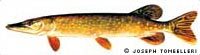
Northern Pike
The state record for northern pike caught was 45 pounds, 12 ounces. The northern pike is an aggressive predator fish found throughout Minnesota in lakes, ponds, and rivers.
A daytime feeder, the northern pike eats mostly fish, especially perch and suckers. Northerns hide in and around underwater plants to ambush their prey. The northern pike is found throughout Minnesota. This fish can tolerate both cold and warm temperatures and can survive in some polluted waters.
Northern Pike tips: Northerns are tough, aggressive and not nearly as fussy as walleyes. It's better to use lures when fishing for these toothy critters. Baits such spoons, crank baits, big spinner baits and wooden plugs called "jerk baits" work well. In shallow, weedy areas, spinner baits, and shallow running jerk baits are best. If the pike are deeper where there aren't many weeds, use spoons and deep running crank baits. Use a 3/8-ounce jig head and attach a long plastic worm. Northern Pike are found on the Whitefish Chain, Gull Lake Chain, Lake Edward, Lower Mission Lake, North Long Lake, and Leech Lake.
Northern Pike Fun facts:
The world record pike (55 pounds, 1 ounce) was caught from a lake in Germany
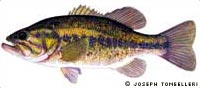
Large-Mouth Bass
The state record Largemouth Bass is eight pounds, 13 ounces. This is one of the scrappiest fish that swims. An increasing number of anglers throughout the state are learning that Largemouth Bass, with their jolting strikes and wild airborne leaps, are exciting fish to catch. Minnesota is becoming known for its largemouth bass. Professional bass fishing tournaments are held in state lakes and rivers throughout the summer.
Largemouth Bass look similar to their close cousin, the Smallmouth. To tell the two fish apart, look at the closed mouth. If it extends back beyond the back of the eye, the fish is a Largemouth. The Largemouth Bass is a popular sport fish because it attacks lures and leaps out of the water when hooked. Since Largemouth aren't considered to be a tasty fish, they are often released after being caught. These aggressive eaters aren't afraid to attack fishing lures.
Largemouth Bass eat underwater insects, other fish, frogs, snakes, and sometimes even ducklings. They use their sense of smell to tell if something is good to eat. Largemouth Bass are found throughout Minnesota in lakes, ponds, impoundments, rivers, and wetlands. Anglers usually find them along underwater weed lines, or in the shade of fallen trees, boulders, and stumps.
Bass tips: Think about fishing from top to bottom. In shallow, weedy areas, use shallow running spinner baits and surface lures that stay above the weeds. If the bass are in four to eight feet of water, use medium running crank baits and spinner baits. If they are down deep, use heavy jigs and deep running crank baits. Bass are tough fighters, so use good fishing gear and strong tackle. Bass in the area are found on the North Long Lake, Gull Lake Chain, Hardy Lake, Lake Hubert, and Bay Lake.
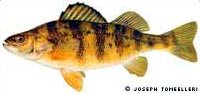
Yellow Perch (Perca flavescens)
The yellow perch is one of the most commonly caught fish in Minnesota. This smaller cousin of the walleye is good to eat and eagerly bites worms, but it often is so small that anglers throw them back into the water. Like sunfish and Bluegills, perch are considered "panfish," or fish caught to be cooked in a frying pan and eaten.
A small fish that is usually yellow on the sides with wide dark bands coming down the sides from its back. Average length is about six inches but some reach a foot or more. Perch eat minnows and the young of other small fish. They also eat insects such as mayflies. Perch are found in lakes, slow-moving rivers, reservoirs, and ponds.
Perch Fun fact: Perch is popular with out-of-state anglers such as those from North Dakota, Wisconsin, and Illinois, where they are a highly desirable fish.
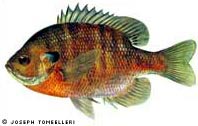
Blue Gill (Sunfish)
Minnesota state record for Bluegill is 2 pounds, 13 ounces and Pumpkinseed is 1 pound, 6 ounces. Minnesota has several sunfish species, but the most popular with anglers are the Bluegill and the Pumpkinseed. The Bluegill tends to grow larger than the pumpkinseed. Though both have a blue spot on the ear flap, the pumpkinseed also has some bright orange at the very edge of the flap. Also, Bluegills tend to be mostly olive colored while pumpkinseeds are more orange colored.
Sunfish are particularly prone to "stunting." Lakes that have good spawning habitat but not much food can produce swarms of small adult Sunnies that never grow larger than four or five inches.
Panfish tips: Panfish often congregate near weeds. Once you find them, you can often catch a lot. For panfish, a good old worm on a hook fished below a bobber is tough to beat. Simply cast near the weeds and let it sit. Move around until you find biting fish. Sunnies are found on the South Long Lake, Gull Lake Chain, Hardy Lake, Nokay Lake, Upper Mission Lake, & Mississippi River.
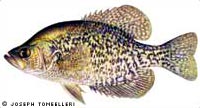
Crappie
The state records for Crappies are: Black Crappie: 5 pounds even and White Crappie: 3 pounds, 15 ounces. Anglers love Crappies. Though the walleye is the state fish, crappies are one of the fish that are caught most often. Crappies bite readily and produce sweet-tasting fillets. There are two types of crappies and both travel in schools and feed on small fish and aquatic insects. If you catch a crappie, it's most likely a black crappie. The black crappie prefers deeper, cooler, clearer water than the white crappie does.
Because they are good to eat, crappies are a favorite fish among anglers. Crappies eat underwater insects, minnows, and other small fish. They feed mostly at sunrise and sunset, which is the best time to catch them. Crappies habitat is small to medium-sized lakes.
Crappie tips: Crappies congregate near weeds. Once you find them, you can often catch a lot. Crappies sometimes like it a little deeper and prefer to feed on minnow. A bobber rig with a minnow for bait is good, as is small pink or white jig tipped with a minnow. Crappies are found on the South Long Lake, Gull Lake Chain, Hardy Lake, Nokay Lake, Upper Mission Lake, & Mississippi River.
Muskellunge
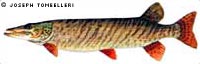
State record for Muskie is 54 pounds, for Tiger Muskie: 34 pounds, 12 ounces. The muskellunge is one of the largest and most elusive fish that swims in Minnesota. A muskie will eat fish and sometimes ducklings and even small muskrats. It waits in weed beds and then lunges forward, clamping its large, tooth-lined jaws onto the prey. The muskie then gulps down the stunned or dead victim head first. The muskellunge, also known as muskie, is a member of the pike family. A large, solitary fish, it is has a reputation as a wild fighter when hooked by anglers. In Minnesota, muskies are light colored and have spots on their sides.
Muskies eat mainly fish. They also may prey on insects, frogs, ducklings, and muskrats. Adults may eat fish up to half their own length, and younger muskies may eat fish almost as big as they are. They feed best in water temperatures of about 70 degrees. Older muskies will live in deeper water. Muskies are found on Leech Lake and Mille Lacs lake.
Muskie Fun facts:
In addition to their sight, muskies use their lateral lines to find food. This is a series of small holes with hairs inside that are scattered around their body surface. When something moves in the water it wiggles the hairs, and the fish can tell a meal is nearby